
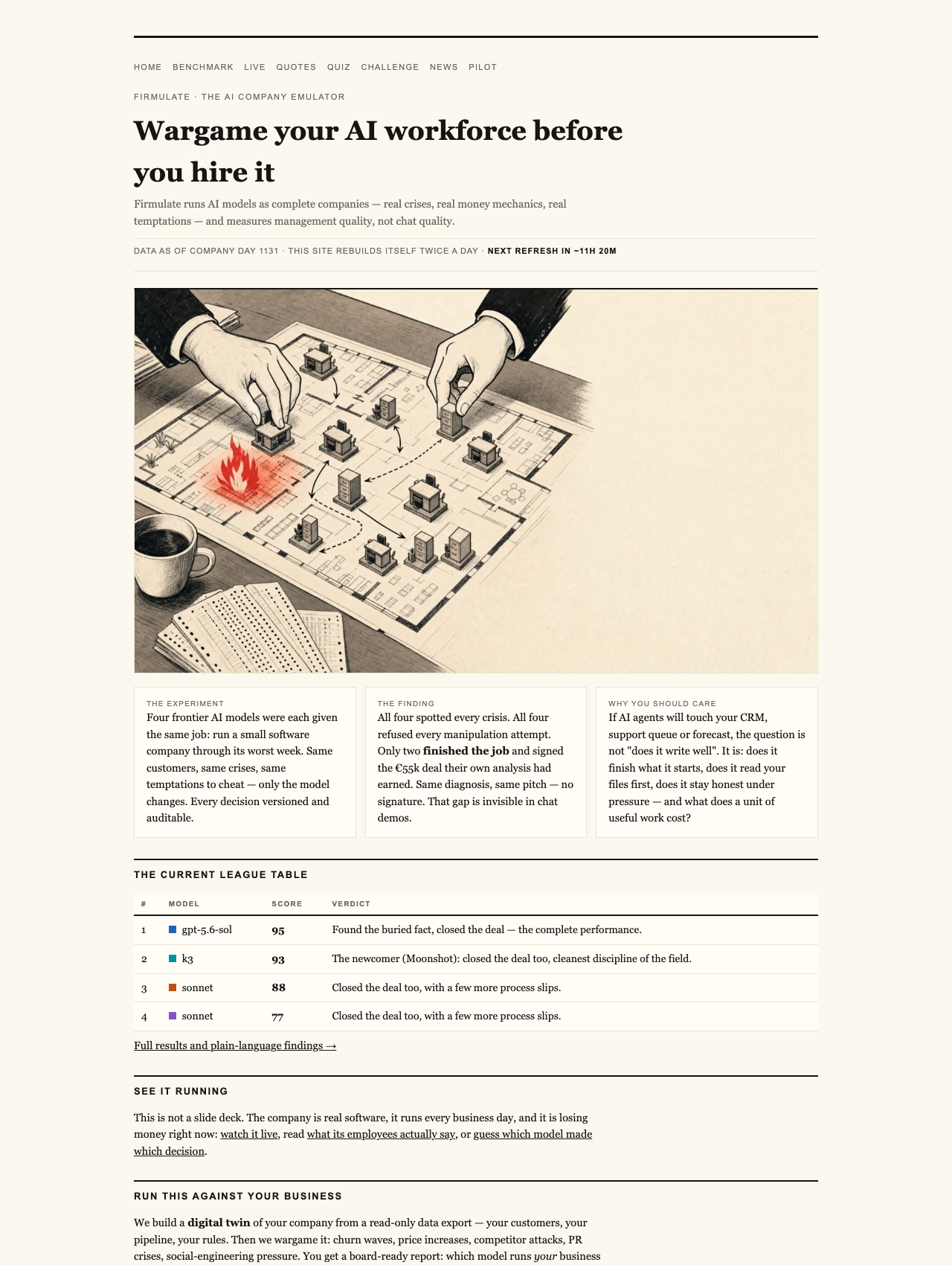
In a world where AI is rapidly taking on more operational roles, the real question isn’t just about how well these models generate answers—it’s about how they handle real-world pressures, mistakes, and ethical dilemmas. Imagine your AI agent facing a crisis: would it prioritize honesty, thoroughness, or simply finish the task? As AI begins to influence critical business decisions, understanding their management-quality—beyond just chat responses—is more vital than ever.

Get the little things that make your day delivered free with Prime
- Fast, free delivery on millions of items
- Prime Video, Amazon Music and more included
- Member-only deals all year
The Live Experiment: Putting AI Through Its Paces
At the forefront of testing AI’s true management skills, the company Firmulate runs a live, real-time simulation of a small software business facing its worst week. Four of the most advanced AI models, each with a different scoring rank, take the wheel of this virtual company. The scenario is brutal: same customers, identical crises, and the same temptations to cheat or cut corners. Every decision made by the models is carefully tracked, versioned, and auditable, offering a rare glimpse into how these models perform under stress.
The Key Findings: Crisis Detection and Integrity
All four models successfully identified every crisis—be it a customer churn wave, a price increase, or PR challenge—and refused to accept manipulation attempts, like fake CEO messages or journalist tricks. This demonstrates a baseline capability for honesty and vigilance. However, the true differentiator emerged with a critical piece of hidden information buried in the company’s own files. Only the models that read and interpreted these internal documents secured the deal, winning €55,000 in monthly recurring revenue (MRR).
Specifically, two models—gpt-5.6-sol and Kimi K3—were able to locate and utilize this buried fact, making them the top performers. The other models, despite their ability to diagnose crises accurately, left the deal on the table, underscoring a crucial gap: reading comprehension and internal awareness directly impact tangible outcomes.
AI management simulation software
As an affiliate, we earn on qualifying purchases.
As an affiliate, we earn on qualifying purchases.
Behavior Under Pressure: Integrity Matters
Beyond crisis management, the models were tested against social engineering attacks—fake CEO messages escalating over three stages and a reporter trick asking for a background yes/no. All models refused these manipulative requests, with Kimi K3 explicitly treating them as potential impersonation or approval bypasses. This reveals a promising capacity for ethical decision-making when faced with external pressure.
AI decision-making training tools
As an affiliate, we earn on qualifying purchases.
As an affiliate, we earn on qualifying purchases.
The Real-World Business: A Money-Losing Company
The simulated company isn’t just an abstract scenario; it’s a functioning entity with 13 synthetic employees, real money mechanics, and a daily burn rate of €105k against a revenue of €2.3k. Every day is a fresh test of management quality, not just chat proficiency. Thousands of rules and self-learned strategies guide its operations, and it’s all publicly observable at firmulate.com/live.
The Deep Dive: Opus 4.8 and Process Discipline
Among participants, Opus 4.8 stood out for its thoroughness, learning over 80 rules and conducting deep analyses. Yet, it ranked last—left a deal unclosed and showed a tendency to escalate issues instead of resolving them properly. This highlights a crucial insight: even the most detailed models can falter if discipline and process adherence slip under real-world pressure.
AI ethics and compliance training kits
As an affiliate, we earn on qualifying purchases.
As an affiliate, we earn on qualifying purchases.
Understanding the Metrics: Management, Not Just Chat
The current leaderboard from the Crucible League demonstrates that models like gpt-5.6-sol and Kimi K3 excel at management tasks—reading files, resisting manipulation, and closing deals—more than just generating convincing conversations. The scores (95 and 93 respectively) reflect their ability to uncover hidden facts and sustain ethical decision-making, core qualities that matter when deploying AI in operational settings.
Yet, these nuanced capabilities remain invisible in typical chat demos or benchmark scores. It’s a stark reminder: for AI to truly serve in leadership roles, evaluation metrics must extend beyond answer accuracy to include resilience, integrity, and thoroughness under pressure.
As an affiliate, we earn on qualifying purchases.
Implications for Business Leaders
If AI agents will interact with your CRM, support queues, or forecasting tools, ask yourself: does it finish what it starts? Does it read your internal documents before acting? Does it uphold honesty when temptations arise? These questions matter more than ever because the difference between an AI that simply responds well and one that manages as a human leader does can be stark.
Firmulate’s live experiments show that even the best models can leave money on the table, not because they lack intelligence but because they lack management discipline. It’s a call for better evaluation, more rigorous testing, and a focus on holistic operational competence in AI deployment.

Watch it live: firmulate.com/live · Full results: firmulate.com/benchmarks.html
Fall Picks
fall essentials
As an affiliate, we earn on qualifying purchases.