This checklist is for anyone putting together a smart desk setup for work, study, or everyday computer use. It covers lighting, screen positioning, foot support, cable management, laptop height, and headphones, with practical guidance for comparing options.

Get the little things that make your day delivered free with Prime
- Fast, free delivery on millions of items
- Prime Video, Amazon Music and more included
- Member-only deals all year
The sections follow the main parts of a desk setup, from lighting and monitor placement to comfort and sound. Each product slot includes a named pick where provided; the monitor stand section offers advice only, since no product was specified.
Use the checklist to measure your space, note your devices and connection needs, and compare each option against how you work. Treat the listed product names as starting points, then check the dimensions and compatibility details before buying.
Adjustable Desk Lamp
A desk lamp can make it easier to direct light where you need it while keeping the rest of your workspace arranged around your screen and tasks. The listed pick is the OttLite LED Desk Lamp with Color Changing Base and USB Port, White. Before choosing a lamp, consider how much desk space its base uses, how far its arm reaches, and whether the light can be aimed at your work area without shining directly into your eyes or screen.
A common mistake is focusing on appearance or extra features without checking whether the lamp fits the desk and the way you work. Measure the available surface and consider where the lamp will sit relative to your monitor, keyboard, and writing space. Check the product details for the lamp’s size, adjustment range, power requirements, and USB port specifications. If you plan to use the port, confirm it suits the device and cable you intend to connect. Also consider whether the color-changing base fits your workspace preferences. Fit and placement matter as much as the feature list: a lamp that blocks a monitor or crowds a small desk may be inconvenient even if its functions sound appealing.
What to look for:
- Check lamp dimensions and base footprint against available desk space.
- Confirm the arm or head can be positioned for your tasks.
- Review power requirements and cord placement.
- Check USB port specifications against the device you plan to connect.
- Decide whether the color-changing base suits your workspace.
OttLite LED Desk Lamp with Color Changing Base and USB Port, White

Modern white LED desk lamp featuring OttLite’s high-contrast, low-glare natural daylight illumination. Offers 3 color temperature modes and 3 brightness settings, with a base that glows in your choice of color or cycles through the spectrum.
Pros:
- High-contrast, low-glare OttLite illumination reduces eye strain
- Adjustable color temperature and brightness settings
- Flexible neck with wide height adjustment range
- Built-in USB port and fun color-changing base
Cons:
- Not water resistant
- Relatively low wattage may not suit users wanting very bright output
Best for: Desk users who want an adjustable lamp with a USB port
Not ideal for: Anyone whose desk has little room for a lamp base
Bottom line: Check the lamp’s footprint, reach, and port details before deciding it fits your desk.
Monitor Stand
A monitor stand raises or positions a screen to help organize the desk and set up a more comfortable viewing arrangement. Since this slot has no specified product, compare stands by the monitor’s dimensions, weight, base shape, and the amount of space you want underneath. A stand should provide a stable surface and leave room for the items you plan to store or place below it.
A frequent buying mistake is choosing a stand based on width alone. Check the listed support limits and dimensions, and consider whether your monitor’s feet will sit securely on the platform. Measure the desk depth and the distance from your seated position to the screen; a stand changes the screen’s position, so verify that the result suits your setup. If you use more than one screen, check the combined footprint and how the screens will align. For a monitor with an adjustable base, consider whether a separate stand adds useful height or takes up space without improving the arrangement. Look for stable support, suitable dimensions, and a layout that leaves your keyboard and other frequently used items accessible.
What to look for:
- Measure monitor base dimensions and compare them with the platform.
- Check the stand’s supported weight in its product details.
- Measure available desk width and depth before selecting a footprint.
- Consider whether you need open storage space underneath.
- Plan screen alignment and viewing distance for your seated position.
Ergonomic Footrest
A footrest can provide a place to rest your feet while you sit at a desk. The listed pick is the Step-to-Adjust Height-Adjustable Foot Rest with Foam Cushion. Its height-adjustable design makes adjustment range an important detail to review. Consider your chair height, desk height, and how your feet rest when seated so you can judge whether the footrest’s available positions make sense for your setup.
One common mistake is buying a footrest without checking its size or adjustment method. Compare the product dimensions with the space under your desk, including any crossbars or drawers that could interfere. Review how the height is adjusted and whether the product details explain the available positions. Consider the cushion material and surface dimensions in relation to how you expect to use it. If you share the desk or change chairs, check whether the adjustment range can accommodate those different arrangements. A footrest that cannot fit under the desk or be positioned comfortably may become an obstruction. Focus on under-desk clearance, adjustment details, and a stable place for your feet rather than relying on the product name alone.
What to look for:
- Measure the clearance under the desk, including crossbars and drawers.
- Check the footrest dimensions against your available floor space.
- Review the height adjustment range and how it is changed.
- Consider the cushion and usable surface dimensions.
- Check that the footrest can sit securely in your intended position.
Step-to-Adjust Height-Adjustable Foot Rest with Foam Cushion
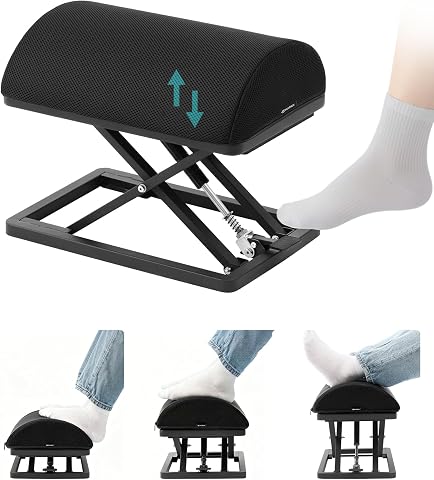
This foot rest adjusts from 2.7 to 13.1 inches with a foot tap, so you can change its height without bending down. It has a carbon steel frame, non-slip pads, and a contoured high-density foam cushion with a removable, washable cover.
Pros:
- Foot-tap height adjustment without bending
- Wide adjustment range for different postures
- Stable carbon steel construction with non-slip pads
- Removable, washable cushion cover
Cons:
- Finger-entrapment risk during operation
- Relatively heavy at 9.5 lb
Best for: Seated desk users who want adjustable foot support
Not ideal for: Anyone with limited clearance under the desk
Bottom line: Confirm the adjustment range and under-desk fit before choosing this footrest.
Desk Cable Organizer
The product listed for this slot is the DeskShow 60 x 30 Inch Electric Standing Desk with Flip-Top Cable Manag. Its name describes a desk rather than a separate cable organizer, so check the product listing carefully to understand what cable-management features are included. For a desk-based setup, cable routing can affect where devices sit, how cords reach outlets, and whether the workspace remains easy to adjust.
A common mistake is assuming that “cable management” in a product name guarantees the exact storage or routing arrangement you need. Review the full product details and images for the locations, dimensions, and access method of any cable-management areas. Measure the desk footprint against the room and check how its placement will relate to nearby outlets. If you use multiple devices, map each power and data cable before deciding whether the setup will work. For an electric standing desk, also consider cord slack and routing across the desk’s movement range; confirm that the listing explains how cables are intended to be handled. Prioritize clear feature details and a workable cable path, and don’t treat the truncated name as a complete specification.
What to look for:
- Verify the full product name and included cable-management features.
- Check desk dimensions against the room and available floor space.
- Review where cable access or storage is located.
- Map device cords to nearby outlets and connections.
- For a height-adjustable desk, check how cables are routed during movement.
DeskShow 60 x 30 Inch Electric Standing Desk with Flip-Top Cable Management
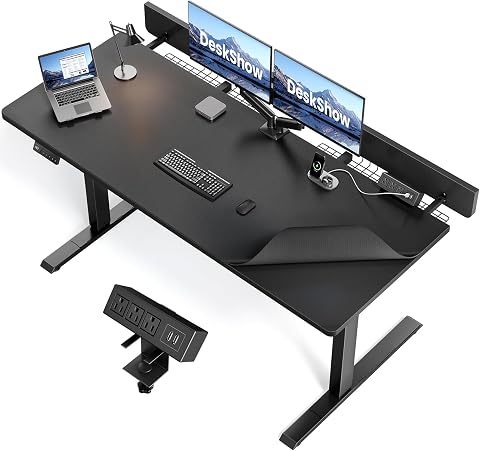
This electric standing desk features a 60×30 inch scratch-resistant top that adjusts from 27.7 to 45.5 inches with three memory presets. Its dual-beam steel frame supports up to 250 lbs, and the flip-top cable management system keeps cords organized.
Pros:
- Sturdy dual-beam steel frame with four support rods
- Quiet lift under 45 dB
- Includes desk pad and clamp power strip
- Scratch-resistant top
Cons:
- Heavy at 78 pounds
Best for: Shoppers considering a standing desk with cable-management features
Not ideal for: Anyone seeking a separate organizer without confirming the listing
Bottom line: Read the complete listing to verify what cable-management features the desk includes.
Laptop Riser
A laptop riser can position a laptop higher or at a different angle on the desk. The listed pick is the Tounee Telescopic Laptop Stand with 360° Swivel Base, Gray. For this style of stand, check the height and angle adjustments alongside the swivel base, then consider how it will fit with your keyboard, mouse, and available work surface.
A common mistake is checking the stand’s maximum height but overlooking its footprint, stability, or compatibility with the laptop. Compare the stand’s supported device dimensions and weight with your laptop’s specifications, and review the product details for adjustment limits. Measure your desk and consider whether the base can rotate without bumping a monitor, wall, or nearby objects. If you type directly on the laptop, consider whether the raised position suits your working arrangement; if you use a separate keyboard, check that there is room to place it comfortably. A stand that swivels still needs enough clearance to turn. Prioritize device fit and desk clearance, and confirm how the stand is intended to support your laptop before buying.
What to look for:
- Check supported laptop dimensions and weight in the product details.
- Review the stand’s height and angle adjustment range.
- Measure the base footprint and room needed to swivel.
- Plan space for a separate keyboard and mouse if you use them.
- Confirm the stand supports the laptop securely in your intended position.
Tounee Telescopic Laptop Stand with 360° Swivel Base, Gray

This telescopic laptop stand adjusts from 2.1 to 21 inches to support seated or standing work. Its 360° swivel base, foldable design, and aluminum alloy construction provide flexible positioning and compact storage.
Pros:
- Adjustable height supports seated and standing positions
- 360° rotating base allows flexible screen positioning
- Aluminum alloy construction with a large base and two pivot joints
- Folds for storage and is compatible with 10–17-inch laptops
Cons:
- Designed for laptops within the 10–17-inch size range
- The stand itself takes up desk space while in use
Best for: Laptop users who want a height-adjustable stand with swivel movement
Not ideal for: Anyone whose desk lacks room for the base to turn
Bottom line: Verify laptop fit and rotation clearance before choosing this riser.
Noise Cancelling Headphones
Headphones can help create a more contained listening setup at a desk. The listed pick is the Bose QuietComfort Headphones – Wireless Bluetooth Over-Ear Noise Cance. The product name is truncated, so use the full listing to confirm the exact model and its features. Consider how an over-ear design will fit, whether Bluetooth suits your devices, and how you plan to use the headphones during work.
A common mistake is choosing headphones by a partial product name without checking device compatibility or fit. Review the complete product details for supported connections, controls, included accessories, and any features you expect to use. Confirm that your computer or other devices can connect as intended, and check whether you need a wired connection for particular tasks. Over-ear headphones can feel different from smaller styles, so consider the fit and comfort information provided by the manufacturer. If you take calls, look for clear details about microphone use and controls rather than assuming a feature from the name. Focus on comfort and compatibility with your actual desk devices, and make sure the listing identifies the full model before you compare options.
What to look for:
- Confirm the full model name from the complete listing.
- Check Bluetooth compatibility with your computer and other devices.
- Review connection options and any included cables or accessories.
- Consider the over-ear fit and comfort details.
- Check microphone and control information if you take calls.
Bose QuietComfort Headphones – Wireless Bluetooth Over-Ear Noise Cancelling Head

These wireless over-ear headphones feature legendary active noise cancellation with Quiet and Aware modes, allowing users to block out distractions or stay aware of their surroundings. They offer up to 24 hours of battery life, high-fidelity audio with adjustable EQ, and multipoint Bluetooth connectivity for seamless device switching.
Pros:
- Effective active noise cancellation with dedicated Quiet and Aware modes
- Long battery life of up to 24 hours with fast USB-C charging
- Multipoint Bluetooth allows seamless switching between multiple devices
- Comfortable plush over-ear cushions and padded headband for extended wear
Cons:
- Requires the Bose Music app for full setup and software updates
- Limited edition color may have limited availability or resale value
Best for: People seeking Bluetooth over-ear headphones for a desk setup
Not ideal for: Anyone who needs a connection type not confirmed by the listing
Bottom line: Confirm the full model, device compatibility, and fit details before choosing.
Build the setup in a practical order: first measure the desk and confirm the screen and laptop arrangement, then address lighting and seating comfort, followed by cable routing and headphones. Prioritize the items that solve the clearest daily inconvenience, and check dimensions and device compatibility before completing the setup.
A comfortable desk comes together through small choices that suit your space and routine. Use the checklist to compare the options, verify product details, and adjust the arrangement as you go. Your workspace can evolve as your needs change.